
 Call Alpharetta
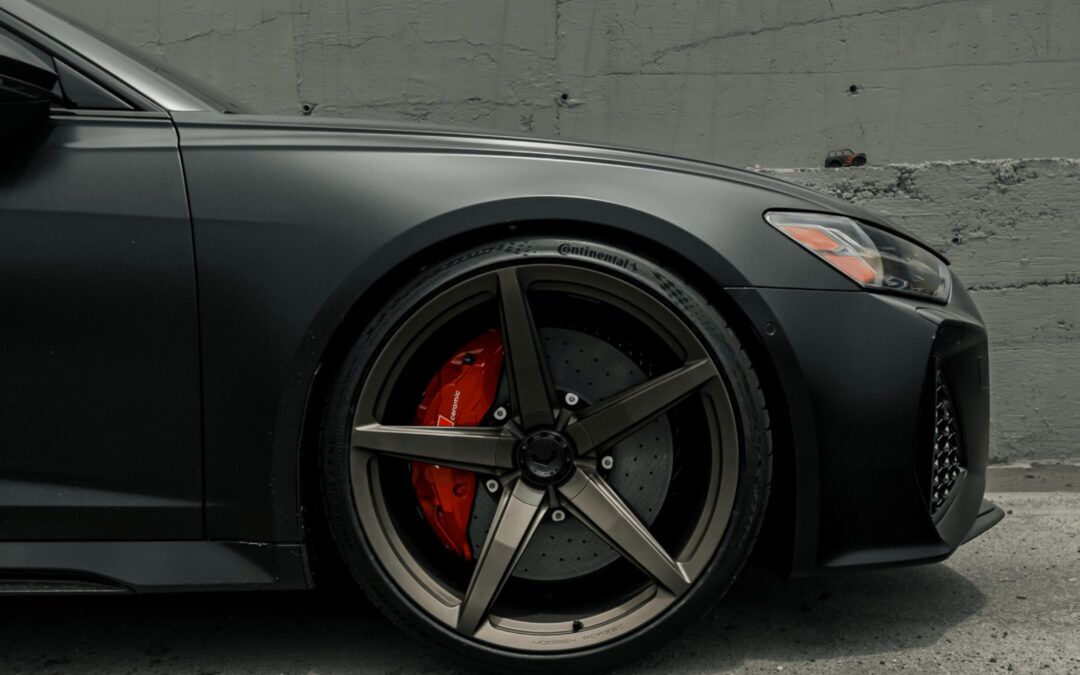
The call usually comes a few weeks after the wheels went on. The car looks exactly the way the owner wanted, and it now crashes over every expansion joint on GA-400 and tramlines down a patched stretch of Old Milton Parkway. Nothing is broken. The wheels did what bigger wheels do, and most of that trade-off was decided the moment the size was chosen, long before anything was bolted on.
Quick Summary: Key Takeaways
- Sidewall height is the variable that matters: a bigger rim on the same overall diameter means less rubber between the wheel and the road, and rubber is where small impacts get absorbed.
- Weight hurts twice: heavier wheels and tires are harder for the suspension to control and harder for the brakes to stop.
- Ratings are not decoration: load index and speed rating are matched to the car, and a stylish wheel with the wrong numbers is the wrong wheel.
- Half a size down is usually the fix: dropping from 21s to 20s or 20s to 19s recovers most of the ride without losing the look.
Sidewall is suspension you cannot see
Your springs and dampers handle the big inputs, the dips and the crests. Everything smaller than that is absorbed by the tire itself, and the only part of the tire with any give in it is the sidewall.
Go from a 19-inch wheel to a 21 on the same car and the overall diameter has to stay close, because the speedometer, the stability control and the gearing all depend on it. The rim grew by two inches, so the sidewall lost an inch of height at each end. That inch was doing real work. What replaces it is a shorter, stiffer wall that transmits a sharp-edged joint straight into the chassis instead of swallowing it.
Atlanta pavement makes this obvious faster than most places. Concrete slab highways with regular expansion joints are exactly the surface that punishes a short sidewall.
What goes up when the wheel goes up
Weight, mostly, and in the worst possible place. Wheels and tires are unsprung mass, so the suspension has to control them directly instead of carrying them on a spring. Add several pounds per corner and the dampers are fighting harder to keep the tire on the road over broken surfaces, which costs grip as well as comfort.
Rotating mass is the other half of it. A heavier wheel takes more energy to spin up and more braking effort to slow down, so acceleration softens slightly and brake temperatures rise on repeated stops. None of this is dramatic on its own. Stacked together, it explains why a car can feel slower and less settled after a wheel change that added no mechanical fault at all.
Wheel damage is the part owners feel in the wallet. With less sidewall protecting the rim, a pothole that used to pinch a tire now bends the wheel.
Load rating and speed rating are matched to your car
Every European manufacturer specifies a minimum load index and speed rating for each vehicle, and both are molded into the sidewall next to the size. An X5 or a Cayenne needs a load index that accounts for a heavy vehicle, and a car with real top-speed capability needs a tire rated for it even if you never go there, because the rating also reflects how the tire handles sustained heat.
Aftermarket wheel and tire packages are where this gets missed, usually because a popular size in the right rating is expensive and a lookalike is not. It is the one corner of this decision with no stylistic argument on either side.
Reading the grades molded into the sidewall
Most passenger tires sold here carry three government grades, and they are easy to use once you know what they compare. NHTSA’s grading system assigns treadwear relative to a control tire scored at 100, grades wet stopping from AA down to C, and grades heat resistance from A to C. The agency notes that 15 percent of current tires are rated below 200 for treadwear while 77 percent earn an A for traction, and reports 511 deaths in tire-related crashes in 2024.
A soft performance tire with a treadwear grade around 200 will grip beautifully and be gone in a season of commuting. That is a fair trade on a weekend car and a poor one on a daily driver, and the number is right there on the tire before you buy.
A winter set changes the arithmetic
If you run a second set of wheels for the cold months, that is the place to go smaller, not larger. A narrower tire on a smaller rim puts more pressure through a smaller contact patch, cuts through standing water better, and gives you back the sidewall you lost on the summer set.
It also protects the expensive wheels from the worst of the season. Atlanta does not get much snow, but it gets cold rain, grit and the occasional ice morning, and that is exactly when a bent rim on a short sidewall happens.
Getting the fitment right before you buy
Offset, center bore, hub centricity and brake clearance all have to be correct, and none of them show up in a photo. The wheel has to sit at the right depth so the suspension geometry is unchanged, clear the caliper with room to spare, and locate on the hub rather than on the studs.
Bring the car in before you order, not after. Twenty minutes spent measuring and talking through sizes beats telling someone their new wheels foul a caliper at full lock.
Frequently Asked Questions
Q: Will smaller wheels make my car look wrong?
A: One step down is barely visible on most European cars once the tire is mounted, and the ride difference is immediate. Two steps down starts to show.
Q: Do I need an alignment after new wheels and tires?
A: If the size changed, yes. It is also the cheapest way to protect a new set from wearing unevenly from day one.
Q: Why does my steering wheel shake only above 65?
A: That is almost always a balance problem, and larger wheels are less tolerant of a small imbalance than smaller ones.
We Will Measure Before You Order
Bring us the car and the sizes you are considering, and we will measure clearance, check the ratings against the vehicle and give you our opinion on how each option will ride on Atlanta pavement.
Solo Motorsports — shops in Alpharetta, Atlanta, Johns Creek and Norcross